

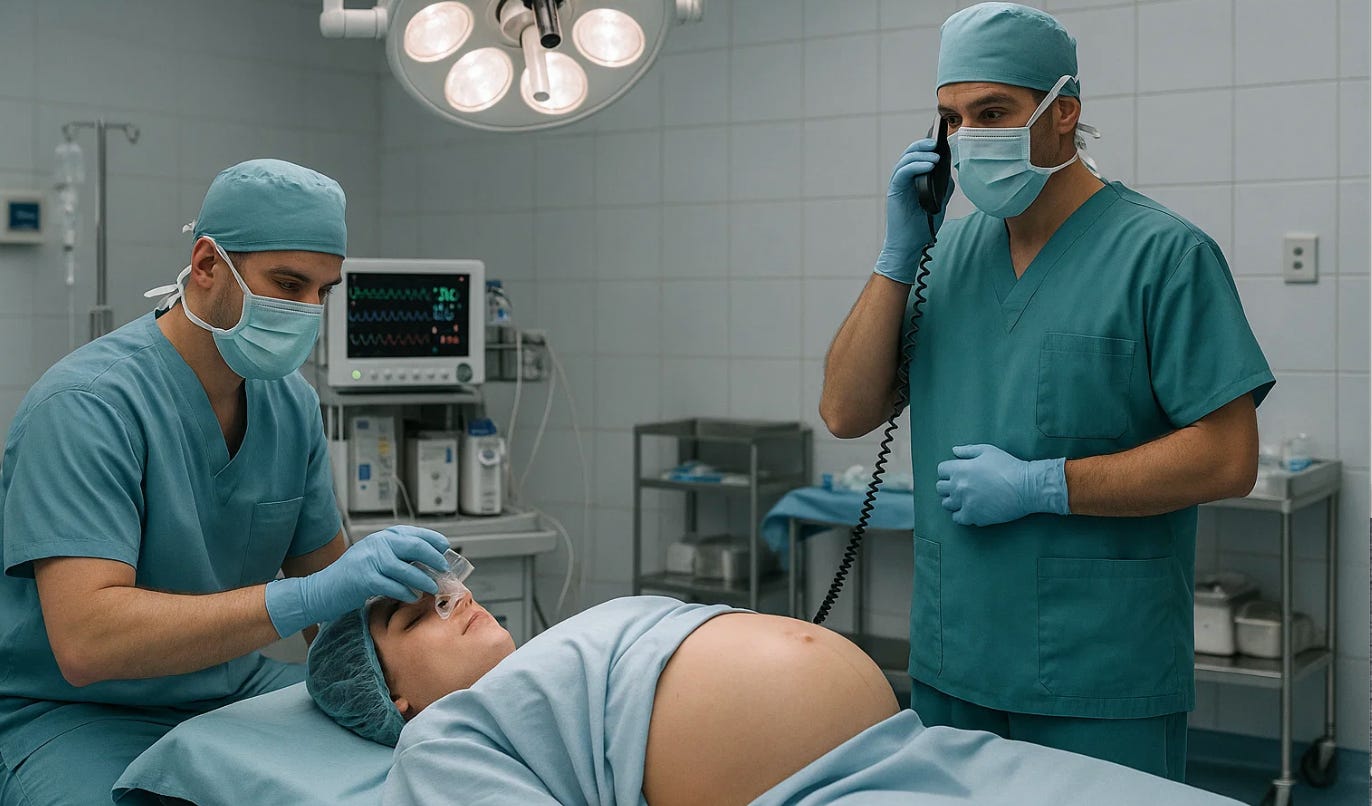
A forced cesarean delivery, a delivery done without the pregnant woman’s consent, is one of the most ethically fraught interventions in medicine.
Ethical guidelines across obstetrics are clear and consistent: pregnant women should not be compelled to undergo a cesarean. ACOG’s Committee Opinion on refusal of recommended treatment argues that even when a physician believes a cesarean is critical for fetal survival, coercion is not ethically defensible.
The principle is grounded in bodily autonomy, human rights, and the recognition that pregnancy does not erase the moral agency of the woman. These documents exist to prevent misuse of power and to ensure that the clinician’s duty of beneficence does not override the foundational ethical rule that competent adults control what happens to their bodies.
The ethical question becomes harder when the clinical situation is not a disagreement about risk tolerance, but a moment in which both patients, mother and fetus, face immediate, fully preventable catastrophe. The definition matters. A forced cesarean in the context of disagreement is categorically unethical. A court-ordered intervention in the context of imminent injury or death for both mother and fetus due to an unfolding obstetric emergency presents a different and far narrower category of concern. These cases are extremely rare. They must remain rare. Yet they also illustrate that autonomy and beneficence can collide in ways that textbook ethics cannot fully anticipate.
The case I lived through still shapes how I understand the limits of theory and the obligations of practice.
We admitted a pregnant woman in active early labor with an incomplete breech presentation. Incomplete breech means the baby is upside down, with the baby’s feet towards the vagina. At the time of admission her cervix was only 3 cm dilated and we felt the baby’s umbilical cord presenting through the fetal membranes. If the membranes ruptured as would be expected, the cord prolapes, and the cord would be compressed preventing blood and oxygen from reaching the fetus, and injuring or killing the fetus.
We explained this to the patient. She needed a cesarean delivery. She refused. Multiple doctors and nurses talked to her. She would not consent to a cesarean. We were stunned, this never happened before. We were watching as the fetus was about to get injured or die. The fetus’s heart beat showed recurrent deep decelerations indicating intermittend blood flow problems. We got the hospital’s lawyers involved and ethics. This was a dire emergency. The lawyers recommended to call a judge. The patient was moved to the OR and I was on the phone with te judge explaining what was going on.
While on the phone with the judge the membranes ruptured, a cord prolapse occurred. This is one of the most unforgiving emergencies in obstetrics. The pathophysiology is simple and brutal. The prolapsed cord is compressed between the fetal presenting part and the maternal pelvis. Once compressed, fetal oxygenation is compromised within seconds. Irreversible injury can occur within minutes. Vaginal breech delivery at 3 cm dilation in the presence of cord prolapse is anatomically impossible. Fetal death is the expected outcome without immediate cesarean. Maternal risk rises quickly as well if operative delivery is delayed. The fetus in front of us was alive and well. It was stressed. Without cesarean delivery within minutes the fetus was not going to stay alive. The fetal heart beat slowed down below 80 beats per minute, call “prolonged fetal bradycardia”.
We recommended an immediate emergency cesarean. The patient refused again. The refusal was not based on religious prohibition, prior trauma, or a coherent risk framework. She stated simply that she did not want surgery and that “the baby will find its way out.” At this point the medical facts were not ambiguous. Vaginal birth was not possible. Continued labor meant a predictable and preventable neonatal death. It also placed the mother at serious risk because prolonged attempts at a nonviable vaginal route during cord prolapse increase hemorrhage, infection, and the likelihood of a hysterectomy. This was not a scenario involving different interpretations of risk. It was a scenario defined by anatomy and minutes on a clock.
We faced a dilemma that every ethical guideline acknowledges but hopes never occurs. When a competent pregnant woman refuses life-saving care for herself, her decision stands, even if the fetus dies. When the refusal simultaneously places her own health in mortal danger, and when the clinical situation allows no reasonable alternatives, the physician’s obligations expand. In this case the nurses were maintaining manual elevation of the presenting part to relieve cord pressure. This is not sustainable for long. Without surgical delivery the fetus would die and the mother would likely suffer major morbidity.
Hearing that we only had minutes to save the baby, the judge reviewed the facts, asked clarifying questions, and issued an emergency court order authorizing the cesarean.
The patient had geeral anesthesia and the cesarean delivery was uneventful. The baby emerged vigorous with a strong cry. The mother had no complications. When she awoke in recovery, fully conscious and stable, she asked about the baby. We told her that her baby was healthy and safe.
She took my hand, began to cry, and thanked us over and over again for saving her child. Her gratitude was sincere and profound.
It did not justify overriding her wishes. It did not retroactively cure the ethical tension. It did make clear that in this narrow clinical context, an intervention she was unable to consent to in the moment had saved both of them from catastrophe.
I saw her the next day when she was holding the baby and she apologized for refusing the cesarean delivery and thanked us again.
This case forces the uncomfortable truth that ethical absolutes can break when the physiology is nonnegotiable and both patients face preventable death. It also reinforces that these cases should not be generalized. They are exceptions because they require a convergence of factors that almost never occur: imminent death for both mother and fetus, no alternative interventions, an anatomically impossible vaginal birth, and a refusal that cannot be grounded in stable, autonomous decision-making under crisis. The solution is not to weaken autonomy but to recognize that ethical frameworks must acknowledge the rare situations in which the physician’s responsibility includes preventing immediate, catastrophic harm when the patient cannot meaningfully process the danger.
Most other hospitals and doctors would have likely not forecd the patient to have a cesarean delivery. Without a cesarean they would have watched the baby get injured or die.
Pregnancy ethics often assume there is time for dialogue and shared decision making. Obstetric emergencies prove that this assumption does not always hold. The challenge is to maintain a principled commitment to autonomy while acknowledging that clinicians must sometimes make decisions that carry ethical weight far beyond the operating room. We must keep these cases rare through better communication, anticipatory guidance, and trauma informed care. When they occur, we must document meticulously, involve multidisciplinary leadership, and approach the legal system only when every other avenue has closed. If at all.
This case reaffirmed for me that ethical practice does not mean refusing to act when action is the only path to prevent irreversible loss. It means holding autonomy and beneficence in tension, staying honest about the limits of both, and accepting the moral responsibility for decisions made under extraordinary conditions.
The case makes the conflict unusually sharp, but I think the narrowness of the exception matters. The fetus's interest in survival cannot by itself explain the override, because competent patients ordinarily retain the right to refuse treatment even when another person's survival depends on their body. What potentially changes the analysis here is the conjunction of imminent danger to the patient herself, the claim that she could not meaningfully process that danger in the crisis, and the absence of any alternative - not fetal benefit alone.
That is close to the burden highlighted by Judith Jarvis Thomson's violinist argument: even granting another being a right to life does not automatically establish a right to use a particular person's body. A critic can still argue that pregnancy creates special parental duties, or that emergency incapacity changes what clinicians may do, but those are additional premises rather than consequences of the right to life itself.
I made a short video for Inkstone, a student-run publication I help run, explaining that distinction through Thomson's analogy: https://inkstone.blog/-ep2-j-j-thomson-s-violinist-is-abortion-really-murder-
It may be useful as a compact statement of the autonomy side, although this emergency case raises further clinical questions the video does not address.
I work in a high risk setting where clinical scenarios like this occur. I find it incredible that you were even able to get a judge on the phone. Our specialty has difficult scenarios at all hours of the day/night/holiday and the court system is not often responsive at those hours.