

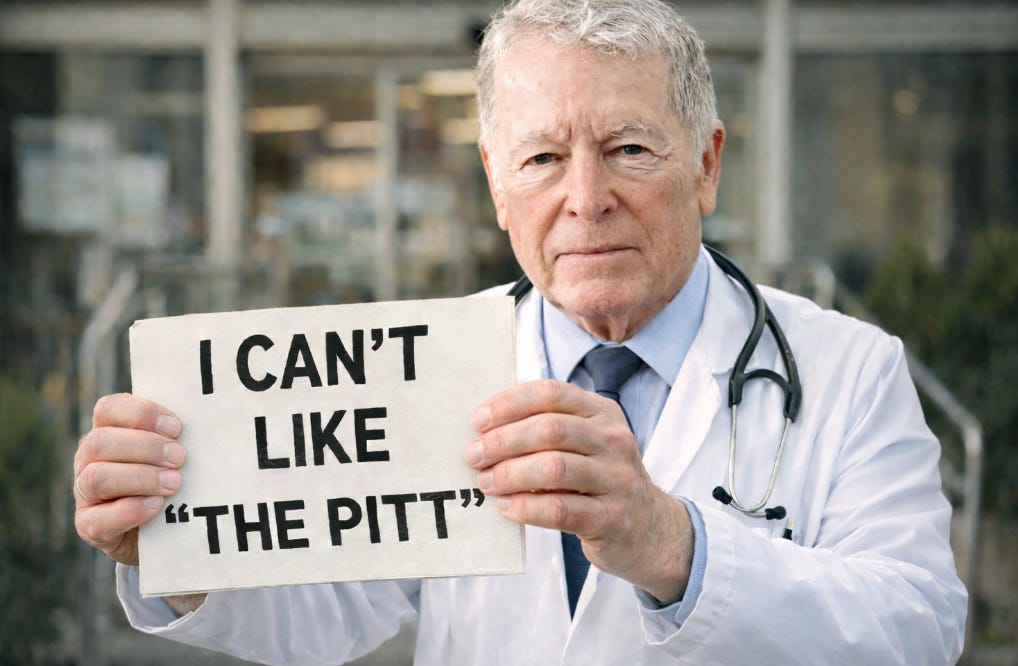
I watched a few episodes of “The Pitt.”
The production is good.
The acting is fine.
The emergency department looks believably chaotic.
And yet something kept bothering me. It took a while to put my finger on it.
The show is built around a doctor who is brilliant, wounded, overworked, and morally superior to everyone around him. He makes the saves. He carries the weight. He is the reason patients live or die.
That is not medicine. That is mythology.
What makes a great doctor
After 50 years in obstetrics, including running one of the largest labor and delivery units in New York City, I can tell you what actually separates good outcomes from bad ones. It is not the charismatic attending with the backstory. It is systems. Protocols. Checklists. Teams that communicate. Nurses who speak up. Residents who are trained, not heroic. Handoffs that work.
The physician personality cult is one of medicine’s most persistent and dangerous myths. It tells patients that if they find the right doctor, the brilliant one, the dedicated one, the one who really cares, they will be safe. It tells young physicians that excellence is a personality trait rather than a discipline. It tells hospitals that one exceptional individual can compensate for a broken system.
None of that is true. And some of it is actively harmful.
What Hollywood gets wrong
“The Pitt” is well-intentioned. I understand the goal: show the reality of emergency medicine, the burnout, the moral injury, the impossible choices. These are real. They deserve attention.
But the storytelling frame undermines the message. When a show centers outcomes on individual heroism, it reinforces exactly the wrong lesson. The patient who survives does so because of the attending’s extraordinary effort. The patient who dies does so because the system was overwhelmed — but the attending tried his best. The individual is always the unit of analysis.
In reality, the unit of analysis should be the institution. The protocol. The team. When something goes wrong in a well-run hospital, the first question is not “who failed?” It is “what failed?” That distinction is the foundation of every serious patient safety framework we have — from the original Lucian Leape work to the Joint Commission standards to the NTSB model I have adapted for obstetric safety.
Hollywood cannot tell that story because it does not have a face.
Why this matters beyond television
I would leave this as a harmless entertainment complaint except that it has real consequences.
Patients often choose physicians based on charisma, not competence.
I can tell you from experience that the “charismatic” doctor is often not the one with the best outcomes.
Medical culture still rewards the cowboy over the team player. Hospitals still protect the brilliant surgeon who terrorizes the OR rather than the quiet hospitalist who documents everything correctly and never misses a handoff.
“The Pitt” did not create this problem. But it feeds it.
Great medicine looks boring on screen.
A well-designed checklist, followed by every team member, every time, without drama, that is what saves lives.
A standardized handoff protocol that ensures the night team knows exactly what happened during the day, that is what prevents errors.
A culture where the nurse can interrupt the attending without fear, that is what catches the near misses before they become tragedies.
The unit I was in charge of never had a maternal death. In 12 years. That is boring.
Our placenta accretas were routinely handled with a full-team approach. Boring.
The NICU attending complained because there were less NICU admissions and less neonatal cooling because we prevented and treated tachysystole by decreasing oxytocin and not using misoprostol. Not waiting until there was a category 3 tracing. That is really boring.
None of that makes good television.
In fact when a television crew came one day to film, there was no material for them to use. They dropped us and went to another hospital. This disappointed our administration.
I understand. But it is the truth.
A recent article in The Cut
A recent article in The Cut profiled the Claudia Cohen Labor and Delivery unit at NewYork-Presbyterian.
Beautiful facility.
Patients appreciated the environment but complained about wait times. The Cut covered all of it.
What the article did not mention is the one thing that actually matters: the Claudia Cohen L&D is located across the street from the main hospital.
In true major obstetric emergencies, and they happen without warning, immediate access to the full resources of a hospital is not optional. It is the system. And the system has to work. A stunning room means nothing if the infrastructure to handle a sudden catastrophic complication is a street crossing away.
This is exactly what “The Pitt” gets wrong, and what that article in The Cut missed for the same reason: both were looking at the surface.
The charismatic doctor. The beautiful unit. The patient experience score. None of that tells you whether the system works when it has to. Patients choosing where to deliver deserve to know that. Neither Hollywood nor The Cut told them.
My Take
I do not watch medical dramas to feel good about medicine. I watch them to see what story medicine is telling about itself.
“The Pitt” tells the story that doctors have always preferred: the individual hero, defined by effort and personality, standing between the patient and death.
After 50 years, I prefer a different story. Not as cinematic. Considerably more accurate.
The best doctors I have known were not the most dramatic ones. They were the ones who built systems so good that when they were absent, nothing fell apart.
The best doctors were the ones you never heard of, and that were part of the team, that created the safest environment, followed or improved protocols, and had the best outcomes.
That is the show I would watch.