

The Question
It appears on Reddit and Social Media constantly, in a hundred variations.
A pregnant woman has a baby in breech presentation and wants a home birth.
Or she is working 65-hour weeks, sleeping five hours a night, eating at her desk.
Or she hasn’t gained enough weight or too much.
Or the doctor told her there isn’t enough fluid (or too much fluid) around the baby.
She is exhausted and frightened, and at some point -- usually late at night -- she opens her phone and types something like this:
Has anyone else navigated this _____ while pregnant? Did your baby turn out healthy and hit their milestones normally?
The thread fills within hours. Dozens of women answer. Most say: yes, I did it, my baby is perfect, you will be fine. The original poster thanks everyone, feels reassured, and goes back to work.
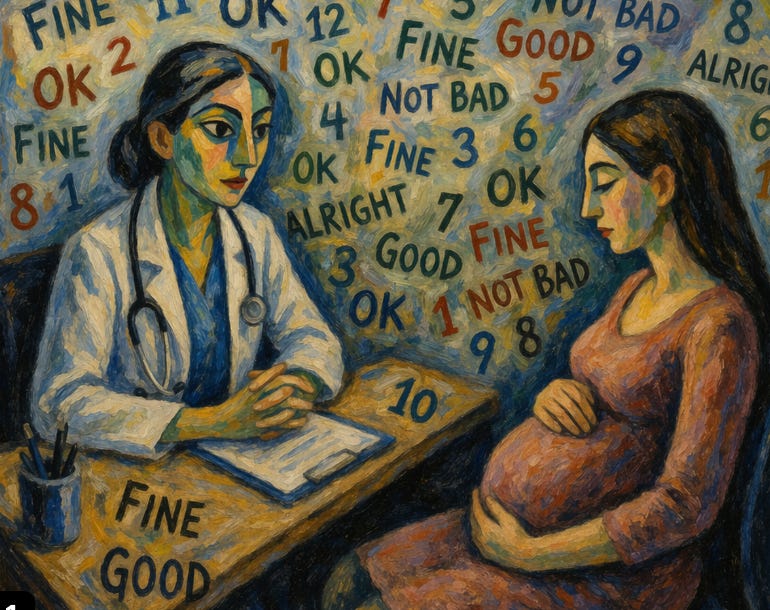
I want to talk about the word fine.
Because fine is doing an enormous amount of work in that thread, and almost none of it is medical.
What Fine Actually Means
Years ago I faced a medical problem of my own -- not obstetric, but serious enough that I needed a specialist. I asked her directly: will the outcome be fine? She said yes, it will be fine.
I am a physician. I know how to ask a follow-up question. So I asked: what percentage of patients with this problem have a good outcome?
She said: seventy to eighty percent.
I want to sit with that for a moment. Seventy to eighty percent. In most contexts, that sounds reassuring. Most people do well. The majority comes through. And by any reasonable definition of the word, she was not lying when she said fine.
But for me, personally, a twenty to thirty percent chance of a bad outcome was not fine. Not even close to fine. It was frightening, it demanded a serious conversation about options, and it changed every decision I made from that moment forward. The word fine had hidden that entirely. It had taken a probability that deserved to be named and buried it under a single syllable of reassurance.
That experience changed how I think about the language of risk. And it is exactly what happens every time a pregnant woman asks Reddit if her baby will be okay and gets back a chorus of yes, mine was fine.
Why “My Baby Is Fine” Is Not Evidence
During World War II, the RAF examined bullet holes in bomber aircraft that returned from missions. The early instinct was to add armor wherever the holes were clustered. A statistician named Abraham Wald pointed out the error: they were only looking at the planes that came back. The planes that were hit in other places did not return. The holes on the survivors told you nothing about where armor was needed -- only where a plane could be hit and still fly home.
This is survivorship bias. It runs straight through every Reddit thread where a pregnant woman asks if other people’s babies turned out fine. The women who answer are the women who are there to answer. Their babies are fine. The women whose pregnancies went differently are less visible in that thread. Some are in a different community entirely. They are not absent because their experience did not happen. They are absent because survivorship bias selects for who shows up.
When a dozen women write “my baby is fine,” the correct interpretation is not: Having a breech at home is fine. Overwork during pregnancy is safe. Not eating the right food is fine.
It is: some women who worked extremely hard during pregnancy had healthy babies. These are not the same statement. One is a personal outcome. The other would be a population-level claim about risk. Personal outcomes, however numerous and however warmly shared, do not become population data. Only the full distribution of outcomes -- including the ones that did not make it into the thread -- can tell you what the risk actually is.
How Doctors Are Trained to Think Differently
When a patient presents a question like this in a clinical encounter, a physician’s training pulls in a completely different direction than Reddit’s instinct does. The community asks: did it work out for you? The physician asks: what does the data show across all the women who faced this situation?
These are fundamentally different questions. The community’s question selects for survivors. The physician’s question tries to account for all outcomes. A physician who has read the literature knows that sustained overwork during pregnancy -- long working hours, high job strain, chronic sleep deprivation -- has been associated in multiple studies with increased risks of preterm birth, low birth weight, and hypertensive disorders of pregnancy. The absolute risk increase for any individual woman is modest. But it is real, it is biologically plausible, and it is not cancelled out by a hundred reassuring replies online.
This is why physicians speak in probabilities rather than anecdotes. Not because they are cold, but because the anecdote of the survivor is structurally unable to tell you the risk. Only population data can do that.
The Informed Consent Obligation
There is a second dimension here that matters more than the statistics alone. Physicians have a legal and ethical obligation to provide informed consent. This means a patient facing identifiable medical risk has the right to receive complete information: what the risks are, what the evidence shows, what can be done to reduce those risks, and what symptoms should prompt her to call. This obligation does not disappear because the patient did not explicitly ask. It does not disappear because the visit is only 15 minutes. It does not disappear because Reddit already told her she would be fine.
Informed consent is not the same as informed reassurance. Reassurance selects the information that makes someone feel better. Informed consent requires providing all the relevant information -- including the uncomfortable parts -- so that the patient can make genuinely autonomous decisions. The woman working 65-hour weeks has a right to know that the evidence links that pattern to modestly elevated risk of preterm birth. She has a right to know her blood pressure trend, whether fetal growth is on track, and at what point she should call. Armed with that information, she can make a real choice. Without it, she is making decisions in the dark, guided by a word -- fine -- that has been stripped of all its numbers.
My own experience taught me that fine is only meaningful when you know what it is measuring. Seventy to eighty percent good outcomes is not fine for everyone. For some patients it will be acceptable. For others it will be the most important number they have ever heard. They deserve to hear it either way. The word fine should never be allowed to stand alone.
My Take
Reddit gives pregnant women solidarity, and solidarity has real value. It tells her that other people have been in this situation and come through it. That is not nothing. But solidarity is not a substitute for a probability, and a probability is not a substitute for a full informed consent conversation.
When I ask a physician about my outcome and she says fine, and I have to ask a follow-up question to discover that fine means a one-in-five chance of a bad result -- something has already gone wrong in that encounter. The patient who does not know to ask the follow-up question will leave believing something that is not true. That is the failure this post is about.
The next time a pregnant patient asks you whether her situation is fine, I would encourage you to resist the word entirely.
Tell her what you know.
Tell her the number.
Tell her what you are watching for, and why.
Let her decide what fine means to her.
She is capable of handling the information. She deserves to have it. And she should not have to go to Reddit at two in the morning to find out that you left something out.