

I wrote this one for patients. Not for clinicians. Not for researchers. For the woman who leaves her prenatal appointment with more questions than answers and no one available at midnight to help her think through them. The setup takes five minutes. The guide is on ObGyn Intelligence at obmd.com.
It is 11:47 at night. You are 26 weeks pregnant. You got your lab results through the patient portal this afternoon. The numbers are there on the screen. Some of them have a little flag next to them -- H for high, L for low. You do not know what any of it means. Your next appointment is in three weeks. The after-hours line is for emergencies only. You are not sure if this counts.
This is where most pregnant women are right now. Not in a crisis. In a gap.
I have delivered more than 10,000 babies over 50 years of practice. The thing that has always troubled me most is not the emergencies -- those arrive with sirens and everyone moves. It is the slow things. The blood pressure that crept up between visits. The fatigue that turned out to be anemia that turned out to be something that could have been caught six weeks earlier. The symptom that the patient mentioned in passing at the end of the appointment, when I was already moving toward the door, and that neither of us gave enough weight.
Prenatal care is built around visits. But pregnancy happens between visits. The surveillance gap -- the time between appointments when no one is watching your data -- is where most preventable complications develop. And for most of the history of obstetrics, there was nothing a patient could do about it except wait and hope.
That has changed. What has not changed is whether anyone is telling you.
I wrote the guide below for you. Not for your doctor. Not for your midwife. For you, specifically, at 11:47 at night with a lab result on your screen and no one available to help you make sense of it.
The setup takes five minutes. You do it once. And from that point forward, you have a place to put everything -- and something to help you understand it.
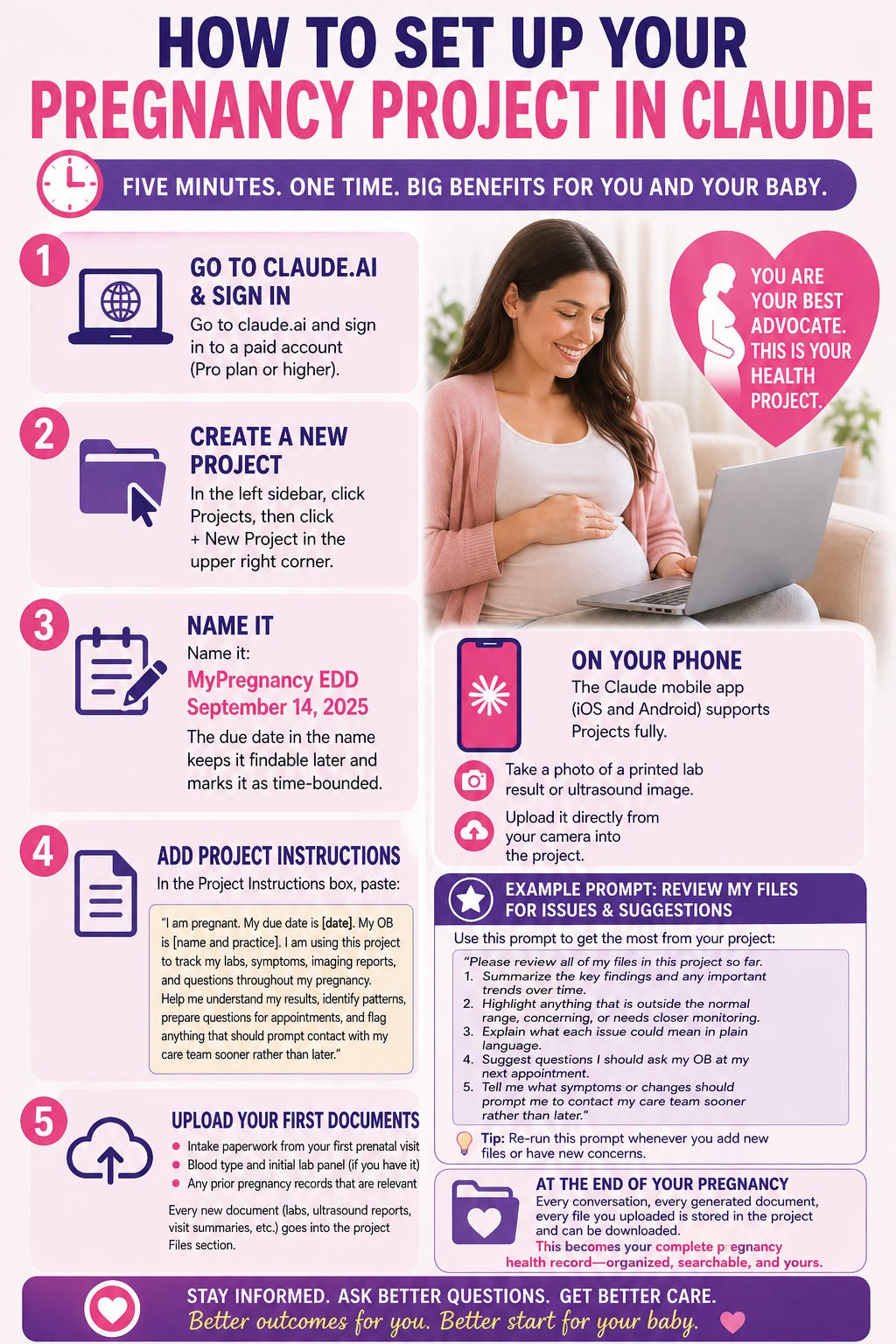
The poster shows you how to set it up. What comes next tells you how to use it -- what to upload, what to ask, what the answers actually mean, and what should make you pick up the phone before your next scheduled appointment.
What follows should be read by every woman who has ever left a prenatal appointment with unanswered questions. By every partner who sat in the waiting room not knowing what to ask. By every patient who was told her symptoms were normal when they were not, by every woman who found her own diagnosis at midnight because no one in the system had the time to find it during the day, and by everyone who has ever wondered whether there was something more she could be doing -- because there is, it is available right now, and no one thought to tell her.
The rest of this post is for paid subscribers.
