

Pregnancy care happens in short visits. The conditions that cause the most harm take weeks or months to develop and are easy to miss. Here is a framework I give every pregnant patient who asks how she can do more than just show up. The full guide is for paid subscribers at obmd.com
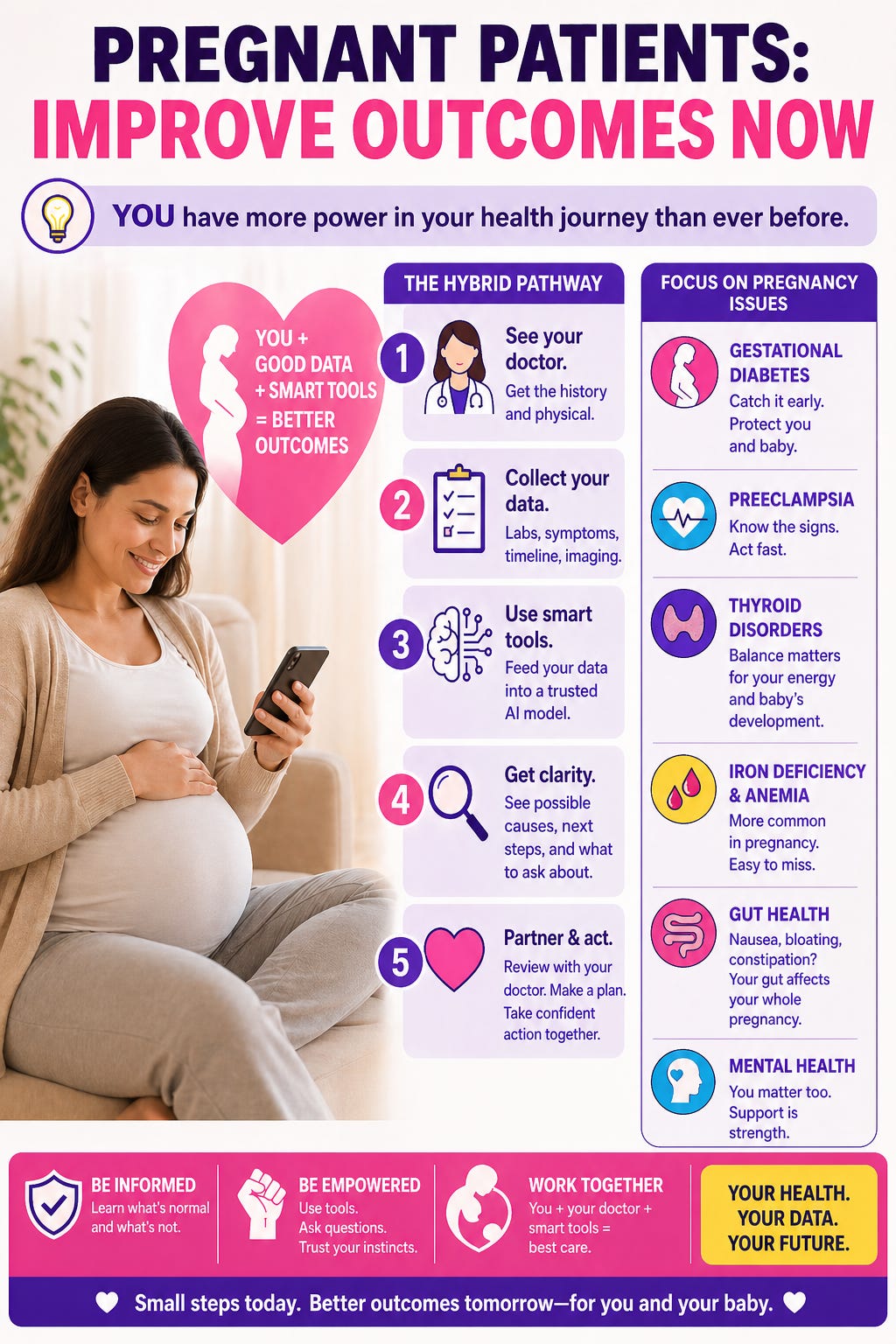
She asked me a question I did not expect: what could she do, between appointments, to make sure nothing was missed? She was 28 weeks. Healthy. No complications. Smart enough to know that most complications announce themselves slowly, across days or weeks, in ways that a visit every four weeks was not designed to catch.
It was a better question than most of the ones I got the office.
The honest answer is that the prenatal care schedule was designed in an era before home monitoring, before frontier AI models, and before patients could order their own laboratory tests in many states. The schedule has not changed nearly as much as the tools available to the woman going through the pregnancy.
What has changed is this: a motivated pregnant woman with access to the right tools, organized data, and a physician willing to engage with what she brings in is in a fundamentally different position than she was ten years ago. The gap between the care she receives in the office and the care she can participate in at home is narrowing. Faster than most physicians realize.
I put the framework I described to her into a single-page poster.
Share it. Give it to your patients. Print it if you still do that sort of thing.
The poster is the summary. What follows is the evidence behind it.
The six conditions on that poster account for a large share of serious pregnancy complications in the United States. Each one has a window where early recognition changes the outcome. Paid subscribers read what that window looks like, what to watch for, and what to bring to the next appointment.
What follows should be read by every ObGyn who has ever watched a preventable complication arrive too late.
By every midwife who has counseled a patient between appointments with nothing but a phone number.
By every pregnant woman who has ever left a seven-minute visit with more questions than she walked in with, by every partner sitting in the waiting room who did not know what to ask, and by every professional society that has spent the last decade updating screening guidelines while the tools that could actually close the gap between visits sat unused in their patients’ pockets.
The rest of this post is for paid subscribers.
