


She was 34 weeks pregnant with twins, preeclamptic, terrified, and alone in triage at 2 a.m. Her doctor sat beside her for a moment, looked her in the eyes, and said: “I know you're scared. I'm here. What do you need to know? How can we work it out together?”
Those sentences contain the entire difference between empathy and compassion. And that difference is not philosophical. It is neurological, measurable, and in obstetrics, potentially life-saving.
We Keep Saying “Empathy.” We Mean Something Else.
Medical education has spent two decades telling doctors to be more empathetic. Empathy training. Empathy scores. Empathy as a core competency. The word shows up in every mission statement and strategic plan.
But empathy, strictly defined, is feeling what another person feels. It is the act of taking on someone else’s emotional state as your own. When a patient is terrified, an empathic physician feels that terror. When a mother is grieving a stillbirth, an empathic provider absorbs that grief.
Compassion is different. Compassion is recognizing another person’s suffering and being moved to act to relieve it. The compassionate physician sees the terror and responds not by absorbing it but by stepping forward with a plan. The internal experience is warmth, concern, and motivation. Not mirrored pain.
This is not a semantic distinction. It is a biological one. And it has profound implications for how we care for women in labor, how we train obstetricians, and why the profession is burning out.
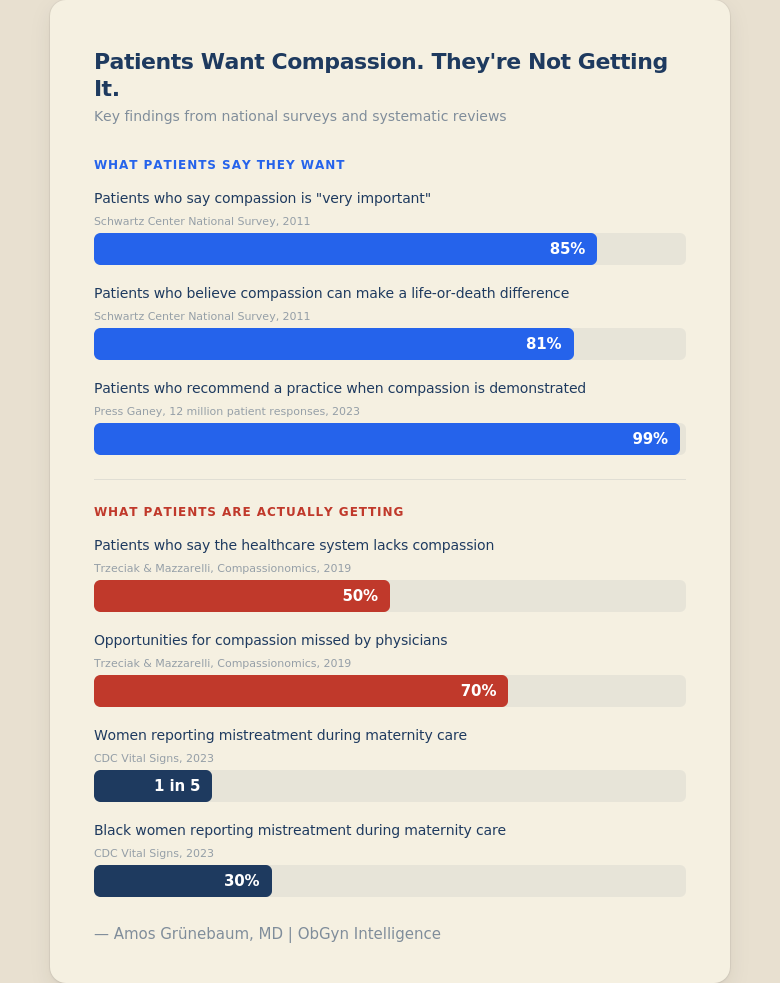
Press Ganey. Evolving consumer expectations in healthcare. Press Ganey HX Insights. 2024.
The exact finding: “When care teams demonstrate all four attributes - providing care that inspires confidence, acting with coordination, and being visibly compassionate - 99% of patients recommend the medical practice.”
Available at: https://www.pressganey.com/hx-insights/the-evolving-expectations-of-todays-healthcare-consumer/
The Brain Knows the Difference
In a landmark series of fMRI studies,………
The following section is for paid subscribers.
