

I have been writing about what medical television gets wrong. “The Pitt” romanticizes the heroic doctor. The beautiful labor and delivery unit across the street from its own hospital gets a flattering profile in The Cut. In both cases, the surface looks good and the system underneath does not get examined.
So let me tell you about a show that gets it right.
What Is “Malpractice”?
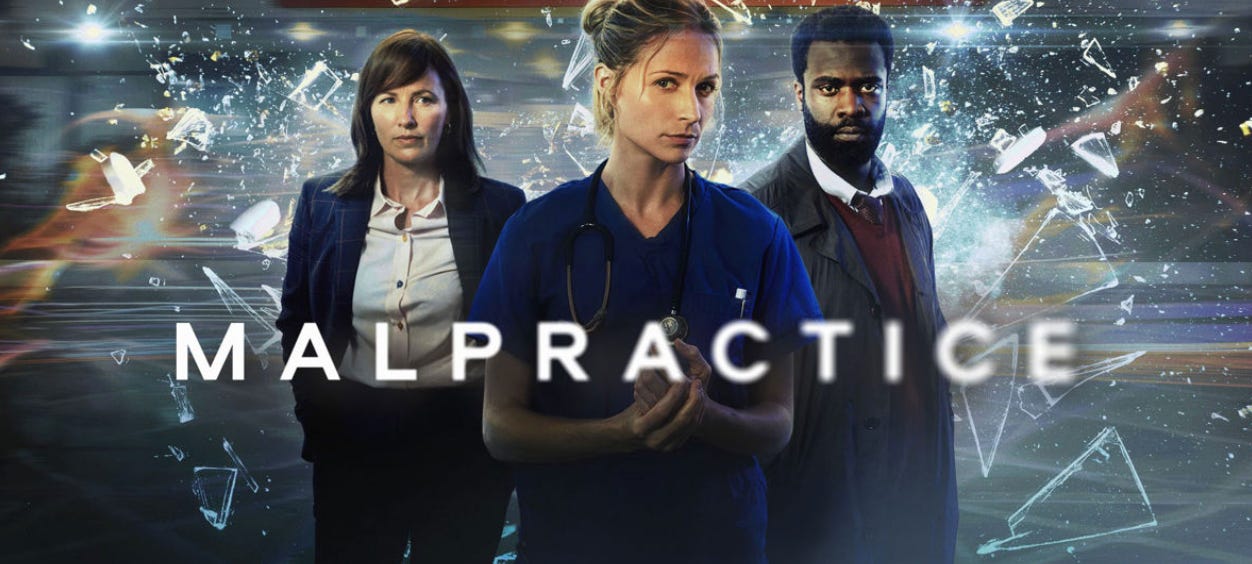
“Malpractice” is a British medical thriller on ITV, now in its second season. It was written by Grace Ofori-Attah, who was a doctor in the NHS for fifteen years before becoming a screenwriter. That background shows in every scene.
Season one followed an A&E doctor whose career unravels after a patient dies under her care. Season two moves to a psychiatric unit. A registrar named Dr. James Ford is pulled in two directions during an impossibly busy on-call shift: a new mother at a postnatal check-up showing signs of distress, and a woman in florid psychosis who needs to be sectioned immediately. He makes a choice. The consequences are devastating.
But here is the thing. “Malpractice” is not really about Dr. Ford. It is about what happens after.
The Medical Investigation Unit
The heart of the show is the Medical Investigation Unit -- the MIU. Two doctors, Dr. Norma Callahan and Dr. George Adjei, are brought in from outside the hospital to investigate what happened. They are independent. They have no loyalty to the institution, no stake in protecting anyone’s reputation, and no reason to look the other way.
What they find in season two is not a bad doctor. They find a broken system. A hospital running on empty. Incident reporting far below the actual number of near-misses. A culture of bullying and cover-ups in which staff are too afraid to speak. Senior administrators more focused on keeping the hospital solvent than keeping patients safe. And at the center of it all, a psychiatric unit that the trust was quietly planning to shut down entirely.
Dr. Ford was not the cause. He was the symptom.
Why This Matters
In American medicine, we have no equivalent of the MIU. When something goes wrong in a hospital, the internal review process is run by the same institution that has the most to lose from the truth coming out. Morbidity and mortality conferences are valuable, but they are conducted by colleagues, in-house, with no independent oversight and no obligation to act on what they find.
The result is predictable. Bad systems get protected. Individual doctors get blamed. The same errors happen again.
I have spent years arguing for an NTSB-style model in obstetrics -- an independent body that investigates adverse outcomes the way the National Transportation Safety Board investigates plane crashes. Not to assign blame. To understand what failed and why, so it does not happen again. The aviation industry transformed its safety record by adopting exactly this approach. Medicine has been much slower to follow.
“Malpractice” dramatizes why that model works. The MIU can go where internal reviewers cannot. They have no relationships to protect, no budget to defend, no political capital at stake. They just follow the evidence. And the evidence, in season two, leads not to a flawed registrar but to a hospital leadership that had been manipulating safety data to hide how dangerous the place actually was.
That is not a fictional scenario. That is real life, written by someone who lived it.
What “The Pitt” Gets Wrong and “Malpractice” Gets Right
“The Pitt” tells you that medicine succeeds or fails based on individual heroism. “Malpractice” tells you that medicine succeeds or fails based on whether the system is honest about its own failures.
One of those stories is more compelling on screen. The other one is true.
The best medical institutions I have seen share one characteristic: they are relentlessly honest about what goes wrong. They do not protect reputations. They do not suppress incident reports. They do not wait for an outside investigation to force the conversation. They build the accountability structure in from the start, because they understand that a cover-up today is a catastrophe tomorrow.
That is the show. That is also the point.
My Take
I rarely recommend television. I am making an exception for “Malpractice.” Watch it not as entertainment but as a case study in what independent oversight looks like when it actually works.
The show was written by a doctor who understood something most screenwriters do not: patients are not saved by extraordinary individuals.
They are saved by ordinary systems that function as designed, and harmed by systems that were never designed to be honest about themselves.
We need an MIU in American obstetrics. We need an independent body with the authority to investigate adverse maternal and neonatal outcomes, with no institutional loyalties and no political cover to provide. Until we have that, we will keep holding M&M conferences, writing up the individual physician, and wondering why the same things keep happening.
A British television drama figured this out. We should too.